
Today, I’d like to share with you some insights on how marketing as a role has changed as a result of the digital revolution and on how the function is likely to evolve in a near future. Particularly, I wish to reflect on the impact these transformations can have on the skills needed to be a successful marketer.
Digital marketing: a new necessity for businesses?
As consumers, many of us now have embraced new technologies. We spend a lot of time online, researching, buying, sharing or interacting. On average, a consumer uses five different electronic devices a day (Cvitanovic, 2018). Digitalization has led to ever-increasing instantaneity and to a so called content shock: consumers are constantly bombarded with information and content to process (Allen, 2017).
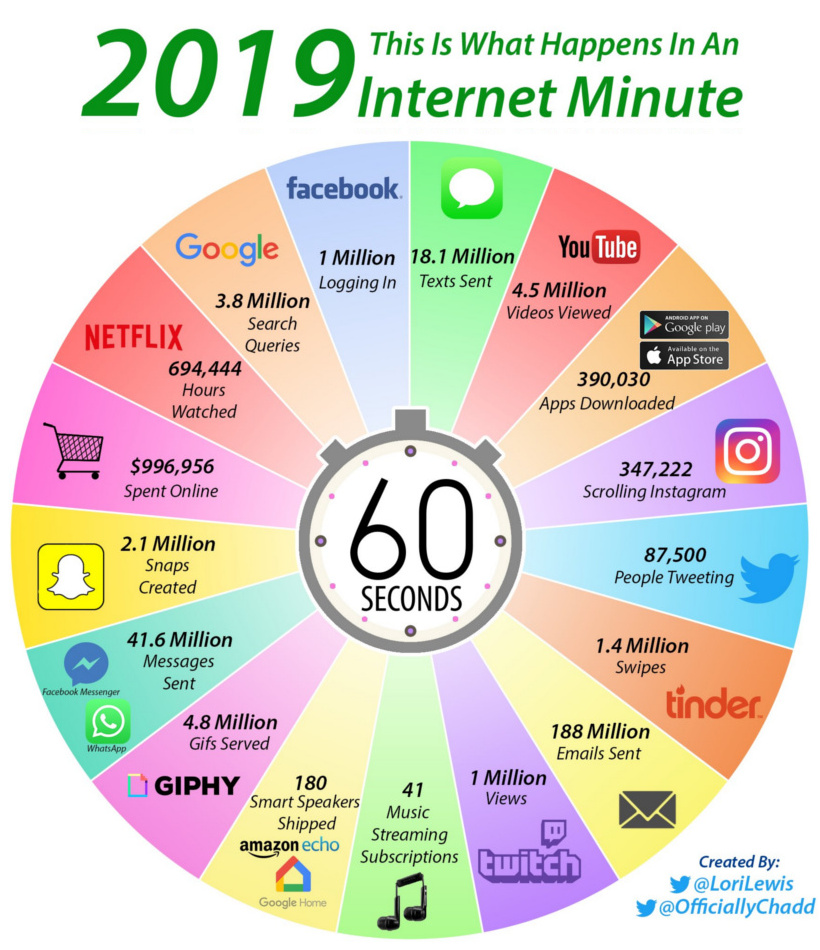
To get customers’ attention in that noisy environment, marketers had to adapt by redefining their strategy and by adapting their skills and activities (Digital Marketing Institute, 2020a). As a result, digital marketing has developed. It designates all types of digital media, data or technology employed and integrated with traditional communication tools to attain marketing objectives (Chaffey & Ellis-Chadwick, 2019). Digitalization has therefore created new possibilities and new tools for marketers, that they have to understand and use if needed (Chaffey & Ellis-Chadwick, 2019). They need for instance to manage big data, to create rich and engaging content or to optimize their search engine results (Digital Marketing Institute, 2020a). The notion of marketing technology has even been introduced to describe all the new technologies used by marketers in their daily job in the 21st century, such as data management platforms or monitoring tools (Patrutiu Baltes, 2017).
The daily job of a marketer is then totally different from what it was 10 or 20 years ago, especially if his or her company has decided to digitalize. In a fast-paced digital environment, marketers need to be agile and to take advantage of new technological tools quickly (Cvitanovic, 2018; Digital Marketing Institute, 2020a). Companies are indeed looking increasingly for talents with an up-to-date digital knowledge and who are able to analyze data to gain deep customer insights (Chaffey & Ellis-Chadwick, 2019).
Some even argue that embracing digital marketing is what will make company success in tomorrow marketplace (Chaffey & Ellis-Chadwick, 2019). It then probably implies that all marketers will need to gain at least basic digital knowledge.
Growth hacking: developing a new mindset?
Have you ever heard of growth hacking? This term originates from Silicon Valley’s tech companies and focuses on marketing as a way to help the business grow quickly and significantly, by testing and improving techniques to reach, interact with and engage customers (Chaffey & Ellis-Chadwick, 2019). It requires a complete change of mindset compared to traditional marketing as it involves to test and to learn by doing.
« Growth hackers are a hybrid of marketer and coder »
Chen, 2012
Even if these techniques are still quite recent and mainly employed by tech companies, they are receiving more and more attention (try to search growth hacking on Google!). Andrew Chen (2012) even argues that growth hacking is the future of marketing. He thinks that the lines between marketing and engineering are blurring, meaning that marketers now need to possess coding and technical abilities to be successful. He also believes that growth hacking requires a complete disruption of the traditional marketing function. Whereas Chen’s predictions may seem a bit extreme (will all marketers really become coders?), I believe that they at least encourage traditional marketers to question their current mindset and skills.
So … What’s next?
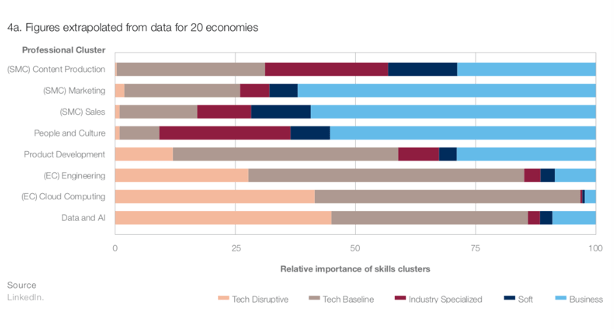
According to the World Economic Forum (2020), 17% of opportunities in emerging professions between 2020 and 2022 will be in marketing, sales and content and will include positions like social media assistant or digital specialist. These jobs will require basic computer literacy as well as specific knowledge depending on the industry, such as online marketing or web design (World Economic Forum, 2020). Many of them will also require an elementary understanding of more advanced technologies such as Artificial Intelligence (Blue, 2020).
A urgent need to up-skill?
Marketing has therefore been tremendously impacted by the digital revolution. If previsions hold true, marketers will have to remain agile and to upskill regularly to be successful in the future. I even think that the need for upskilling is quite urgent, as many companies today face a digital skill gap (Digital Marketing Institute, 2020b).
Marketing is then a good illustration of our need to become life-long learners and to keep developing new skills through our career, to keep pace with technological developments (Government Office for Science, 2017). To conclude this post, I’d like to share with you this Ted Talk by Carol Dweck (2014), who explains the importance of developing a growth mindset as opposed to a fixed mindset. I find this particularly relevant and insightful to prepare for the challenge that is to be a life-long learner!
That’s all for me, but I would love to hear your thoughts, so don’t hesitate to leave a comment in the dedicated section!
References
Allen, R. (2017, February 6). What happens online in 60 seconds? [Weblog]. Retrieved from https://www.smartinsights.com/internet-marketing-statistics/happens-online-60-seconds/
Blue, A. (2020, January 24). 5 things we know about the jobs of the future [Weblog]. Retrieved from https://www.weforum.org/agenda/2020/01/future-jobs-and-skills-in-demand/
Chaffey, D., & Ellis-Chadwick, F. (2019). Digital Marketing: Strategy, Implementation and Practice (7th ed.). Harlow: Pearson.
Chen, A. (2012, April 27). Growth Hacker is the new VP Marketing [Weblog]. Retrieved from https://andrewchen.co/how-to-be-a-growth-hacker-an-airbnbcraigslist-case-study/
Cvitanovic, P. (2018). Navigating New Marketing Technologies, Channels and Metrics. Managing Global Transitions: International Research Journal, 16(4), 379-400.
Digital Marketing Institute. (2020). 9 Ways Digital Has Changed Business Forever. Retrieved February 10, 2020 from https://digitalmarketinginstitute.com/blog/9-ways-digital-has-changed-business-forever
Digital Marketing Institute. (2020). Missing the Mark: The Digital Marketing Skills Gap in the USA, UK & Ireland. Retrieved February 10, 2020 from https://digitalmarketinginstitute.com/blog/missing-the-mark-the-digital-marketing-skills-gap-in-the-usa-uk-ireland
Dweck, C. (2014, December 17). The power of believing that you can improve | Carol Dweck [Video file]. Retrieved from https://www.youtube.com/watch?v=_X0mgOOSpLU
Government Office for Science. (2017). Future of Skills and Lifelong Learning. Retrieved from https://assets.publishing.service.gov.uk/government/uploads/system/uploads/attachment_data/file/727776/Foresight-future-of-skills-lifelong-learning_V8.pdf
Patrutiu Baltes, L. (2017). Marketing technology (Martech) – the most important dimension of online marketing. Bulletin of the Transilvania University of Brasov, 10(59), 43-48.
World Economic Forum. (2020). Jobs of Tomorrow: Mapping Opportunity in the New Economy. Retrieved from http://www3.weforum.org/docs/WEF_Jobs_of_Tomorrow_2020.pdf


Hello, I’m Jing. After reading your post, I think the basic skills of data analysis are necessary for today’s technologically advanced social environment, but at the same time, when doing digital marketing, marketers must not forget the essence of marketing, which means marketers must have basic knowledge about brands, media, and consumer psychology. Only focus on technology is limited. Here’s an article that I think will be helpful.(https://digitalagencynetwork.com/importance-combining-digital-traditional-marketing/)
Also, I’m curious about what skills do you think are necessary for marketers?
J’aimeJ’aime
Hello, I am Siquan. After reading your post. I don’t think all marketers need to be digital experts, but they need to have specific skills, such as how to use digital technology or to have particular learning abilities. However, the ability to focus solely on employees is limited, and companies need to have the ability to inspire employees to use technology.
I have worked in the real estate sales industry for two years. I used social media to connect with customers, collect and analyze customer information. As the company’s reputation grew, these data became more and more massive. Some salesperson was trying to find better techniques to make data collection more convenient, while others were opponents of new technologies.
How to encourage traditional marketers to accept new ways of thinking and skills, I think this post will help.
(https://hbr.org/2015/03/convincing-skeptical-employees-to-adopt-new-technology)
I’m curious about are there other ways to encourage traditional marketers to embrace new ways of thinking and skills?
J’aimeAimé par 1 personne
A well written article. The impact that digitisation has had upon marketing has been tremendous. Digital marketing may have started off as a somewhat niche field, but it has now grown to become the primary means through which most marketing departments operate. I agree with your point that many marketers will need to become constant learners in order to keep up with the current pace of technological advancement. I witnessed this first-hand during a brief tenure as a marketing intern in which my supervisor informed me that he had begun to learn how to code in HTML in order to aid him in advert concept design. The use of data analytics also appears to have become all important within most marketing departments indicating that the future of the field definitely lies within this direction.
J’aimeJ’aime